
How to Build a Successful College Planning Office
Apply

The Business Model Matters: How to Build a Successful College Planning Office
Why the Right Systems, Strategy, and Business Model Can Make the Difference Between Owning a Job and Building a Valuable Business
A Through Z College Planning | AZCollegePlanning.com
Are you building a business, or simply creating another job for yourself?
That is one of the most important questions any business owner can ask.
Entrepreneur and investor Alex Hormozi recently discussed a concept that every current and prospective college planning office owner should understand:
The business model you choose can have a greater impact on your financial success than how hard you work.
Two people can work equally hard, put in the same hours, and have similar skills, yet one builds a highly profitable business while the other struggles to grow.
Why?
Because they are operating under different business models.
At AZCollegePlanning.com, we’ve spent more than 19 years developing our college planning strategies, working with families, and learning what it takes to operate a successful college consulting business.
As we expand into new markets, including Tulsa, Oklahoma, and Orlando, Florida, our goal is not simply to open additional offices.
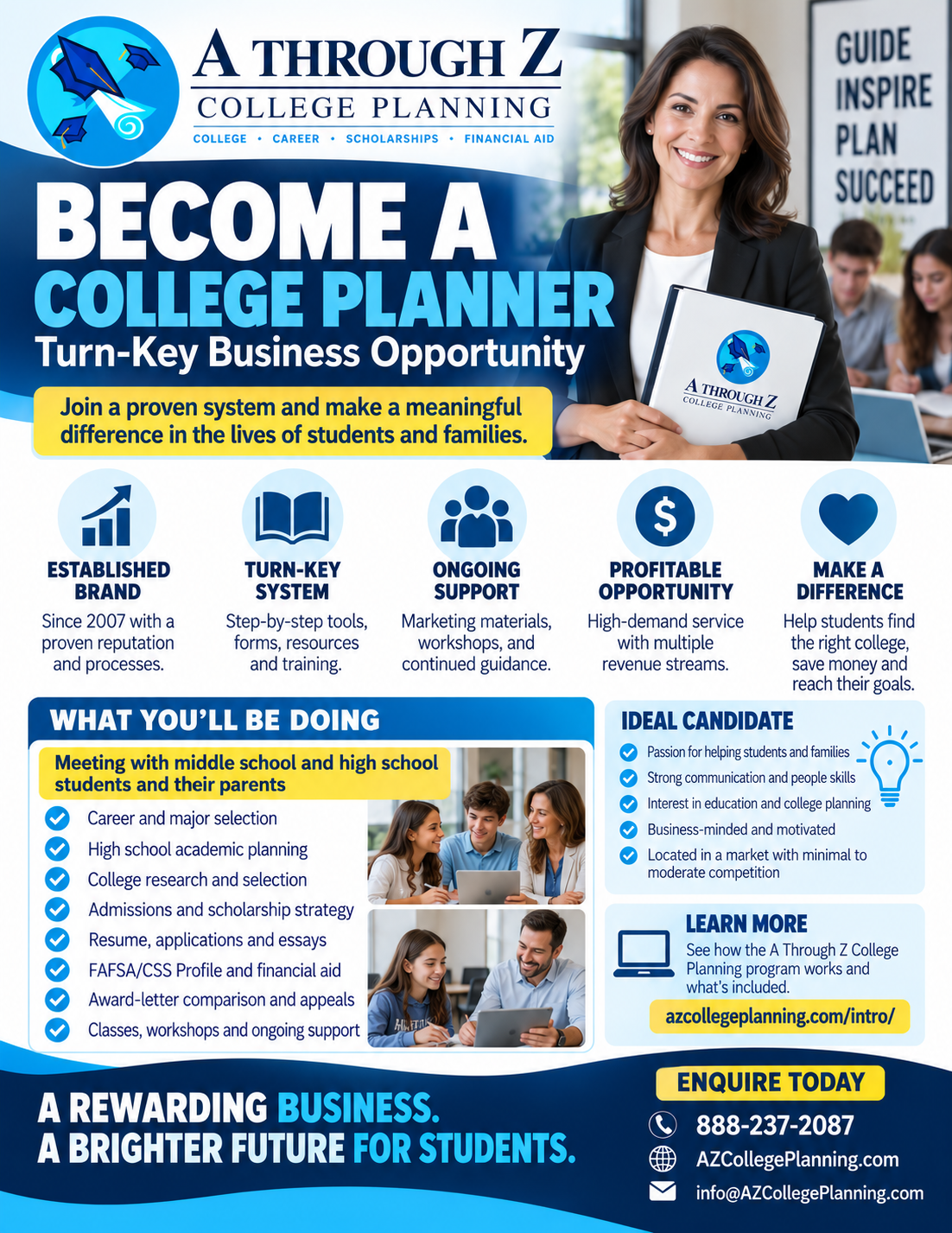
Our goal is to build a repeatable business model that allows qualified college planning professionals to succeed without having to reinvent everything themselves.
- The Problem With Traditional Consulting Businesses
College planning is an expertise-driven business.
Parents seek professional guidance because they want their students to attend colleges that are academically appropriate, financially manageable, and aligned with their future career goals.
They need help understanding admissions, scholarships, financial aid, career selection, and the many decisions that can affect their student’s future.
That creates an opportunity for qualified college planning professionals.
But there is a problem.
Many consultants build businesses that depend entirely on their personal time.
They handle the marketing. They answer the phone. They conduct consultations. They work with students. They follow up with parents. They manage the administrative work.
Eventually, they discover that they don’t really own a scalable business.
They own a demanding job.
When they stop working, the business slows down.
When they want to expand, they discover that everything depends on them.
That is precisely the challenge we want our new AZCollegePlanning.com offices to avoid.
- Don’t Reinvent the Wheel, Use a Proven System
We’ve Already Built the System—You Just Need to Follow It
One of the biggest advantages of joining AZCollegePlanning.com is that we’ve already done the hard work of developing, testing, and documenting our business processes. We’ve created a comprehensive system with step-by-step instructions, word-for-word scripts for prospect calls, workshop follow-ups, consultations, and client communications. You don’t have to guess what to say or how to handle different situations. Our dedicated Staff Page includes training materials, proven procedures, and recordings of actual client meetings that you can watch, review, and learn from. You can see firsthand how we conduct consultations, communicate with parents, explain our services, and work with students. This isn’t just theory or a training manual, it’s a real-world operating system developed through 19 years of experience. Our expectation is simple: study the materials, watch the meetings, follow the scripts, and consistently implement the system. You don’t need to reinvent the wheel. We’ve already built it.
Imagine opening a new college planning office and having to figure out everything from scratch.
How do you attract parents of eighth through eleventh graders?
How do you get families to attend informational workshops?
What do you say when you follow up with a prospective client?
How do you conduct a complimentary consultation?
How do you explain the value of comprehensive college planning services?
How do you organize the student planning process?
How do you maintain relationships with families for several years?
Every one of these questions represents a potential obstacle.
And every mistake can cost time, money, and prospective clients.
At AZCollegePlanning.com, we have spent nearly two decades developing strategies and processes to address these challenges.
Our business model includes:
- Marketing: Educational workshops, digital marketing, referral development, and parent outreach.
- Sales: Structured consultations, follow-up procedures, and methods for communicating the value of professional college planning.
- Student Services: Career assessments, college research, admissions strategies, scholarship planning, financial aid guidance, and ongoing accountability.
- Operations: CRM procedures, student organization systems, monthly reminders, and standardized workflows.
- Training: Helping counselors understand both the technical aspects of college planning and the business skills necessary to operate an office.
The objective is straightforward:
New offices should benefit from the lessons, strategies, and systems developed over 19 years, not spend the next 19 years figuring them out independently. Just follow our proven roadmap.
- Your Competitive Advantage Is More Than College Knowledge
Alex Hormozi emphasizes the importance of developing what investors call a competitive moat.
A moat is something that makes a business more difficult for competitors to duplicate.
In college consulting, simply knowing how to complete the Common Application is not much of a competitive advantage.
Neither is knowing the FAFSA deadlines or editing college essays.
Those services are widely available.
A stronger competitive advantage comes from combining specialized expertise with a comprehensive, repeatable process.
At AZCollegePlanning.com, our approach extends beyond helping students apply to college.
We focus on helping families:
- Identify potential career paths before selecting colleges.
- Develop a strategic college list based on academic fit and affordability.
- Understand how colleges evaluate applicants.
- Position students for admissions and merit scholarship opportunities.
- Understand demonstrated interest and other college-specific admissions factors.
- Evaluate financial aid and scholarship offers.
- Avoid unnecessarily overpaying for college.
- Develop a plan to graduate in four years or less with a career-ready degree.
We also emphasize ongoing communication and accountability.
Parents frequently tell us that their students are more receptive to guidance from an experienced third-party professional than from their own parents.
That creates another important benefit: we help families stay organized, informed, and on schedule.
The value isn’t simply the information we provide. It’s the organized system that helps families put that information into action.
- Marketing Is Not Optional
One of the biggest mistakes a new business owner can make is assuming that being good at the service automatically produces customers.
It doesn’t.
You can be an exceptional college counselor and still struggle financially if parents don’t know you exist.
That is why our office model places substantial emphasis on marketing and lead generation.
One of our primary marketing strategies is the free informational college admissions and scholarship workshop.
These workshops introduce families to important topics they may not fully understand, including:
- Why students with similar grades can receive dramatically different scholarship offers.
- How colleges evaluate applicants.
- Why planning before senior year matters.
- How families can identify opportunities to reduce college costs.
- Common admissions and financial aid mistakes.
The workshops provide valuable information while introducing parents to our services.
But conducting the workshop is only part of the process.
The follow-up is where many businesses fail.
Suppose 50 parents register for a workshop.
Perhaps only 10 to 20 actually attend.
An inexperienced office might focus exclusively on those who attended and ignore everyone else.
That is a mistake.
All 50 registrants expressed an interest in college planning.
Every registrant deserves appropriate follow-up.
Some may be ready to schedule a consultation immediately. Others may need additional information or another invitation.
A successful office needs a system for contacting prospects, tracking conversations, scheduling consultations, and following up consistently.
Marketing generates opportunities. Follow-up converts opportunities into appointments. A strong consultation process helps convert qualified prospects into clients.
Each step matters.
- Build a Business That Can Grow Beyond You
This is perhaps the most important lesson from Hormozi’s discussion.
A business that depends entirely on the owner’s personal involvement has limited scalability.
A business with documented systems, trained employees, consistent service delivery, and predictable client acquisition has greater potential to expand.
For AZCollegePlanning.com offices, that means developing processes that can eventually be performed by trained team members.
Consider the difference.
Office A: The Owner-Dependent Model
The owner personally handles every consultation, every student appointment, every parent question, every marketing activity, and every administrative responsibility.
Revenue is constrained by the owner’s available time.
I ran this model for years and was very successful at it. Then I added one employee, then a second. Each employee I added gave me back more time.
Office B: The Systems-Based Model
The owner develops a local marketing strategy, follows an established consultation process, uses standardized student service procedures, and gradually trains additional counselors and support staff.
The business has the potential to serve more families without requiring the owner to personally perform every task.
Office B is not guaranteed to be more profitable. Staffing, training, and management create additional costs.
However, it has a clearer path toward growth.
The long-term goal should be to build an office that operates through effective systems, not one that survives only through the owner’s constant personal involvement.
- Understand the Value of Long-Term Client Relationships
College planning offers another attractive business characteristic: the opportunity to develop multiyear relationships with families.
Unlike businesses that must constantly replace one-time customers, college planning can begin as early as eighth or ninth grade and continues through high school.
Families may need different types of support as their students progress. And many of them have siblings!
Eighth and Ninth Grades: Career exploration, academic planning, extracurricular strategy, and understanding the college admissions process.
Tenth Grade: Career research, college exploration, testing preparation, and developing a stronger student profile.
Eleventh Grade: College list development, scholarship positioning, testing strategy, demonstrated interest, and admissions preparation.
Twelfth Grade: Applications, essays, financial aid, scholarship offers, college selection, and enrollment decisions.
College Years: Additional assistance with financial aid, academic planning, and other student services where appropriate.
This relationship-based model offers several potential advantages.
It creates opportunities for referrals, sibling enrollments, and continued services.
More importantly, it allows the counselor to provide meaningful guidance over time rather than trying to accomplish everything during a student’s senior year.
For office owners, understanding the lifetime value of a client is essential.
The objective should not be simply to make a sale.
The objective is to develop a trusted relationship that delivers lasting value to the family.
- Why Our Expansion Strategy Matters
AZCollegePlanning.com began serving families in August 2007.
Over the years, we’ve worked with thousands of students, helping them navigate admissions, scholarship opportunities, financial aid, and career planning.
Our Scottsdale, Arizona, office serves as the foundation of our business.
With expansion into Tulsa and Orlando, we’re applying the lessons learned from operating an established college planning company to additional markets.
Our vision is to develop offices that share common standards, systems, and strategies while allowing local professionals to build relationships within their communities.
Each office needs to understand five essential responsibilities:
- Generate leads consistently. A business cannot survive without a steady flow of prospective clients. ✔️ We have this dialed in. It’s a machine!
- Convert leads into consultations. Every workshop registration, inquiry, and referral deserves professional follow-up. ✔️ Scripts and follow up procedures, yes we have that!
- Convert qualified consultations into clients. Families need to understand the value of comprehensive college planning. ✔️ Yes, just follow the plan.
- Deliver exceptional student services. Strong marketing means little if the client experience does not meet expectations. ✔️ Yes, every meeting has been recorded and documented, just follow the plan.
- Monitor business performance. Office owners must understand revenue, expenses, appointment conversion rates, client satisfaction, and profitability. ✔️ Yes, we have tracking sheets so you stay on course to hit the revenue goals you want.
These five responsibilities form the foundation of a sustainable college planning office.
- The Opportunity Is Bigger Than Helping Students Apply to College
There are many individuals and companies offering college admissions assistance.
Some focus on essays.
Others focus on applications or test preparation.
Our approach is broader.
We believe families benefit from understanding the relationship between career selection, college choice, admissions positioning, scholarships, and the total cost of earning a degree.
A student who gets admitted to a prestigious college but graduates with excessive debt may not have achieved the best financial outcome.
Likewise, a student who receives a substantial scholarship to a college that does not offer an appropriate academic program may not have found the right fit.
Our mission is to help families evaluate the entire college planning process.
The right college. The right career strategy. The right financial decision.
For prospective office owners, this creates an opportunity to offer a comprehensive service rather than compete solely on application assistance or hourly counseling.
- Success Requires Following the System
No business model guarantees success.
Opening an AZCollegePlanning.com office does not eliminate the need for hard work, consistent marketing, professional development, and accountability.
The difference is that a new office can start with an established framework rather than an empty playbook.
But even the best system produces limited results when it isn’t followed.
A workshop registration that never receives a follow-up call is a missed opportunity.
A consultation that isn’t properly prepared for may result in a lost client.
A family that doesn’t receive consistent communication may become dissatisfied.
A counselor who fails to follow established procedures can create unnecessary problems.
Consistency is what turns a good strategy into a repeatable business process.
The most successful office owners will be those who combine professional expertise with disciplined execution.
- Think Like a Business Owner, Not Just a College Counselor
There is an important difference between being an excellent college counselor and operating an excellent college counseling business.
A counselor focuses primarily on helping students.
A business owner must also focus on marketing, sales, operations, financial performance, employee development, and long-term growth.
Both skill sets matter.
Our objective is to help new offices develop both.
That means asking questions such as:
- How many new prospective families contacted the office this month?
- How many registered for a workshop?
- How many scheduled a complimentary consultation?
- How many consultations resulted in new clients?
- What is the average revenue per new client?
- How much does it cost to acquire a client?
- Are existing families receiving the services and attention they were promised?
- Can the office grow without sacrificing service quality?
These are the questions that help determine whether an office is building a sustainable business.
Final Thoughts: Don’t Just Open an Office, Build an Asset
Alex Hormozi’s message provides a valuable lesson for anyone considering starting or expanding a business.
Working harder is not always the answer. Building a better business model can be far more important.
For college planning professionals, the opportunity is to combine meaningful work with sound business practices.
Helping students find appropriate colleges, identify scholarship opportunities, and avoid costly mistakes can be professionally rewarding.
Building a profitable, well-managed office that consistently delivers those services can also create long-term business value.
At AZCollegePlanning.com, our goal is to provide new offices with the tools, training, marketing strategies, and operational systems necessary to pursue both objectives.
We’ve spent more than 19 years developing our approach.
The next chapter is about helping additional offices implement it, refine it, and build successful local businesses.
Don’t simply create another job for yourself. Build a college planning business with systems, consistency, and the potential for long-term growth.
A Through Z College Planning
Serving families since August 2007
AZCollegePlanning.com
888-237-2087
Scottsdale, Arizona | Tulsa, Oklahoma | Orlando, Florida
For prospective college planning office owners: Learn how our established college planning strategies, marketing systems, and student service processes can support the development of your local office.